Give me the quote
“The thing that the great players all have in common is they raise the level of those around them.”
Sean Sweeney, introductory press conference, 41:53
Players can reach the destination of “great” through many paths. Some players are known for their individual brilliance while not contributing much in terms of team chemistry or elevating the level of play around them. Many of Wilt Chamberlain’s seasons and the career of Allen Iverson fit the bill here. Other players reach greatness with a reputation for not only exhibiting their own skills, but also lifting the performance of their teammates. Guys like Bill Russell and Magic Johnson carry this distinction. In Sweeney’s quote, he references Paolo and Franz as guys who lift the level of those around them. Let’s take a closer look at what that means.
What exactly are we talking about when we say someone “makes teammates better”?
Sweeney’s point is that the great players he values most are those that elevate the level of play of their teammates. He specifically calls out Paolo and Franz as players who fit this category.
It’s clear why a coach would have a preference for a player who lifts those around him. A front office should value such a player for their overall contribution to the team, not just their counting stats. A coach should have a keen understanding of the lineups that can effectively eat minutes with less shooting or creation alongside such a player. A team looking to trade for such a player should have strong conviction that the ability to elevate teammates will travel successfully to a new roster.
When we say something to the effect of “making teammates better,” there are several different ways to arrive at this conclusion. Does the player actually contribute to improving the performance of their teammates? Or does the player simply change the way their teammates play, perhaps taking shots away from worse shooters or creating more open looks for better shooters? Maybe the player benefits as a complement to a certain teammate or archetype, but does not have the same talent-raising effect with other teammates.
To attempt to quantify this, I tested two versions of Sweeney’s claim. The first asked whether a player changed a teammate’s offensive opportunities, and whether that change appeared again with a new teammate. The second asked whether allowing a player’s impact to change with the strength of the other four players improved future lineup predictions.
Both tests found patterns worth examining, but neither produced a reliable player-level “floor raiser” label.
Did current teammate relationships contain a real signal?
For the first test, I treated every teammate relationship as directional. I wanted to see if one player’s offensive opportunities changed when they shared the floor with a specific teammate, not just whether the two players performed well together compared to other player combinations.
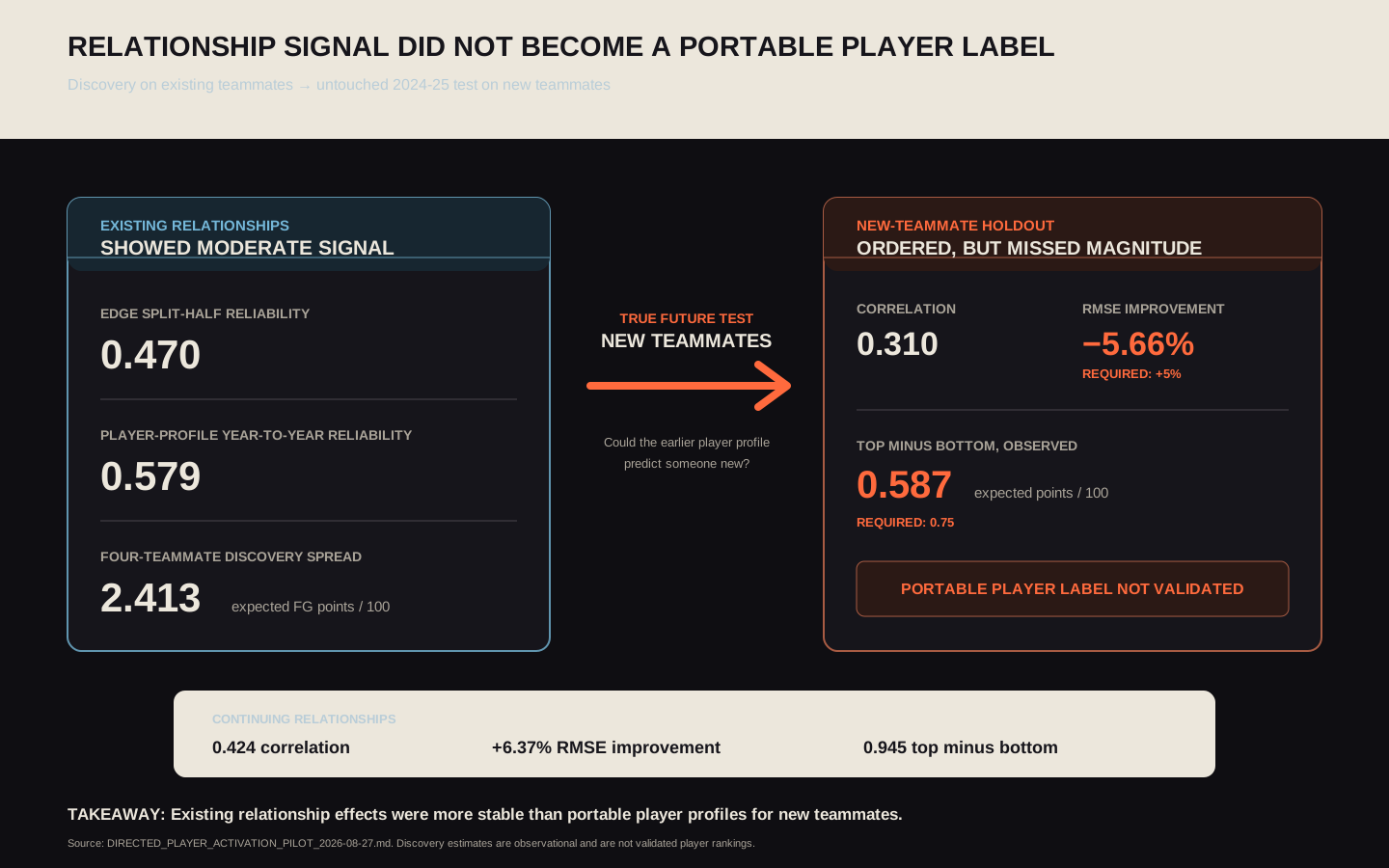
Across the 2022–23 and 2023–24 seasons, we had a sample of over 7,500 qualifying relationships with the median pair sharing 469 possessions. We see moderate stability from the estimated effects when dividing games into separate samples and when comparing player profiles across seasons. We found a measurable signal in existing teammate relationships, but we need to tease out just what that signal represents.
A stable relationship effect isn’t automatically a stable skill that we can attribute to a player. Before we can say if a player elevates a teammate, we need to distinguish whether he creates better opportunities or just reallocates attempts. Or, maybe the player benefits from a relationship that may not exist elsewhere.
It’s all about the shooter
After digging into the data, we see the estimated teammate effect followed FGA volume almost perfectly, presenting a correlation of 0.993 between the overall opportunity profile and the attempts-per-100 profile (that’s a really strong correlation for the non-statheads reading this).
When we moved from the negative to the positive profile group, we saw teammates gain 1.215 expected field-goal points per 100 possessions, and 1.177 field-goal attempts. The per-attempt expected field-goal value changed by only -0.0015. The rim, non-rim-two and three-point shares were almost flat.
What this means is that our model mostly identified players associated with teammates taking more or fewer shots, not that these teammates reached better broad locations or created more expected value per attempt.
Moving attempts towards better players certainly helps a lineup. A star player can also create value by taking a potentially dead possession and making it viable through their individual heroics. Our public-data test couldn’t determine whether the shot redistribution was good, was produced by the role and lineup, or was caused by the player being evaluated.
Now we’re left with the question of whether this was indeed a skill. Could we expect to see it show up when the player shared the floor with a new teammate?
Ehh, kind of
We have 2,240 supported new teammate relationships in the 2024–25 season. This group includes 1,520 relationships that could be predicted from the source player’s earlier profile.
These predictions had a correlation of 0.310 with the observed results, meaning they kept some information about ordering. On average, players with stronger historical profiles were more likely to end up on the stronger side of the results.
The predictions turned out a little too aggressive. The RMSE, a measurement of observed errors, was 0.746 (the lower, the better). A naive approach of predicting zero effect for every new relationship gave an RMSE of 0.706. This means the model was about 6% worse than assuming no effect.
The groups at the top and bottom of the predictions also finished 0.587 expected points per 100 apart. This fell short of our pre-set requirement of 0.75 points.
The relationships that continued across seasons performed better. For teammates who already had history together, the prediction error improved by 6.37% over the zero baseline. The top-to-bottom gap reached 0.945 points per 100 possessions. This tells us the model found established relationships better than it predicted what a player would do for a new teammate.
Can we tell who lifts a weak lineup?
The relationship test looked at teammate opportunities. A distinct test asked whether a player’s adjusted impact changed based on how much “prior” talent the other players provided.
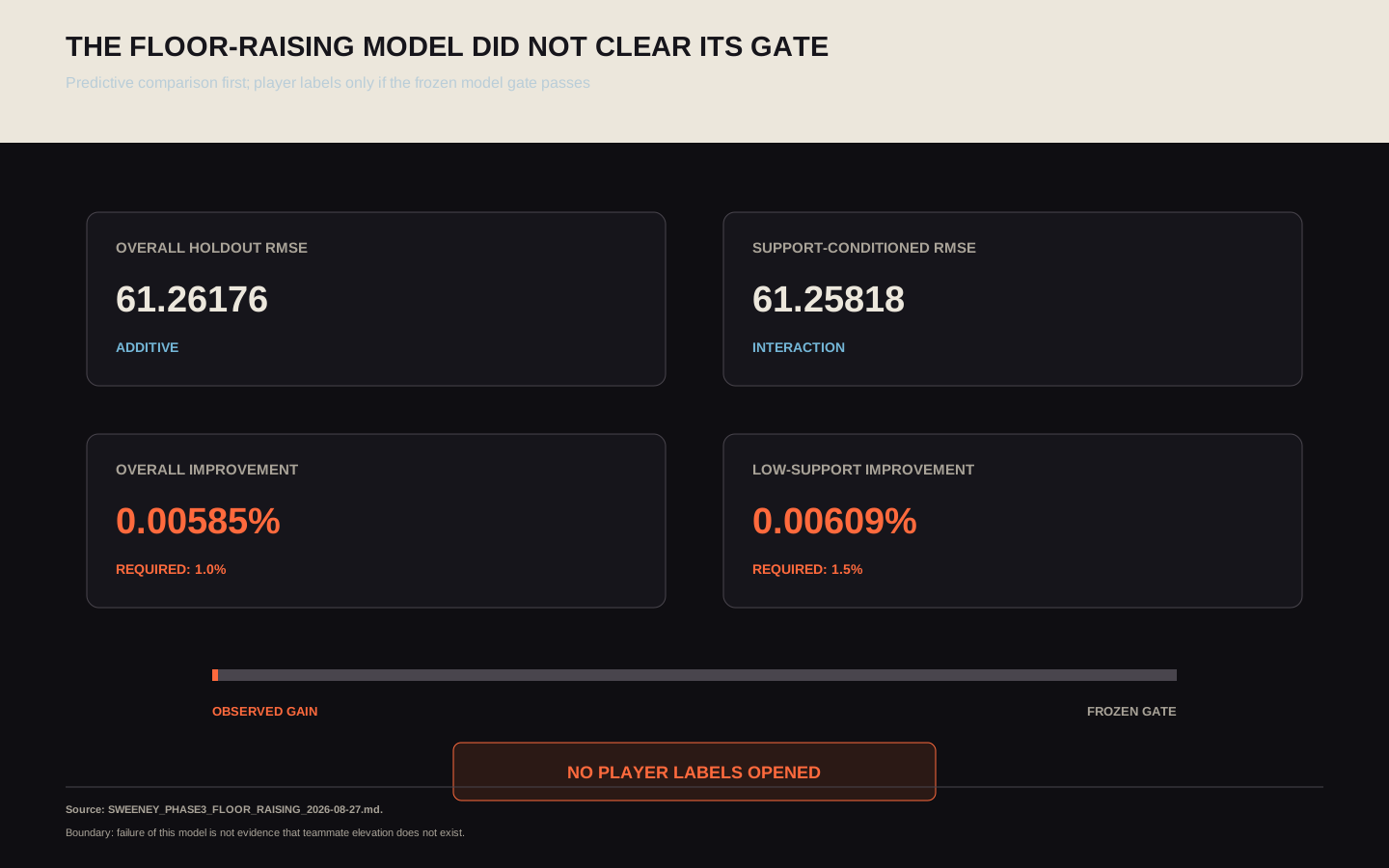
For a baseline model, we treated each player’s contribution as additive. The second model allowed that contribution to move with the support of his teammates. If we could find a repeatable skill through the interaction, we’d expect it to improve predictions for a future set of lineups. We should expect to see the effect even more where the supporting cast was weak.
And, well, it didn’t. The additive holdout error was 61.262 and the support-conditioned model reached 61.258. A measly 0.006% improvement.
The second model improved the future prediction by too little to justify classifying individual players. This doesn’t seal the conclusion that Orlando lacks players who can lift the talent around them; it means that the data we looked at with the models we chose couldn’t prove this.
Did we learn anything useful?
Well, we didn’t end up with a list of certified floor raisers. We found that a player can have a measurable, stable relationship with teammates that fails to translate to a new team. A lineup featuring a star player can perform well while not proving the star would keep the same performance with a weaker supporting cast.
Of course, the Magic have access to lots of data that I do not. They can look at things like touch sequences, play calls, defender locations, decision timing, intended reads, and coaching assignments, to name a few. There is plenty of data out there that could support what I could not through my exploratory analysis above.
Orlando has access to information that public analysis does not: touch sequences, play calls, defender locations, decision timing, intended reads and coaching assignments. That data could separate useful advantage creation from simple shot redistribution. It could also test new combinations before the regular-season sample becomes large enough for a public model.