Basketball
How Much "Talent" Does Sean Sweeney Inherit?
Series 01 / 03What We Heard From Sean Sweeney. What Orlando's Numbers Can Show.
- Published
- September 2, 2026
Welcome to Orlando, Sean Sweeney! The Orlando Magic have parted ways with Jamahl Mosley after five seasons and are putting the team in the hands of first-time head coach Sean Sweeney. In his introductory press conference, Sweeney made several statements that we’ll be diving into in order to put some data behind the sentiments and figure out what to expect out of the Magic with a new figure in the lead seat. The first statement we’ll be looking at is:
“There’s obviously talent here - number of talented guys that I’m excited to coach.”
— Sean Sweeney, introductory press conference, 12:59
How Do We Measure Talent?
As Sweeney put it, Orlando obviously has talent on the roster. But so does every NBA roster. So how can we think about the shape of Orlando’s talent relative to other teams, and why Sweeney might be particularly excited to coach this group?
When looking to quantify talent, there are a number of metrics we could reach for. EPM, RPM, VORP, BPM, etc. all attempt to provide a single number by which we can rank a player. For our purpose of looking to understand what talent Sweeney inherited going into the 2026–27 season, a forward-looking player-impact metric that accounts for estimated minutes coverage will allow us to best isolate where across the roster the unique talent positioning lies. We’ll be turning to the excellent work of Kostya Medvedovsky and his DARKO DPM (Daily Plus Minus).
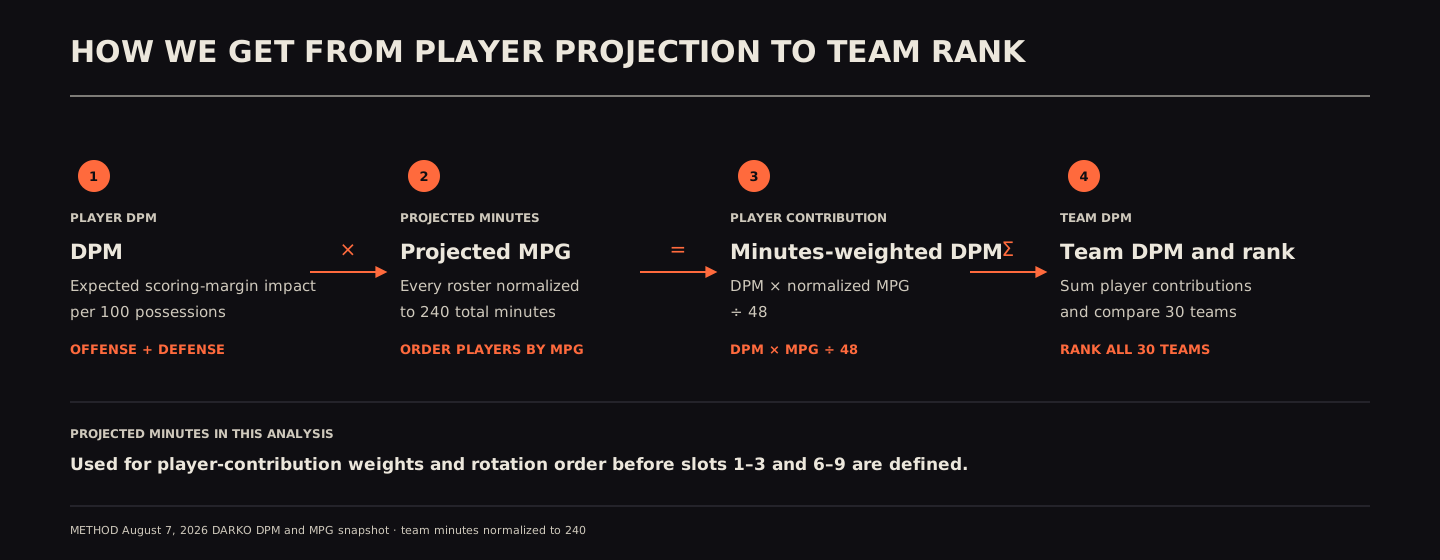
DARKO looks at a player’s entire career while placing a higher emphasis on recent performance. DARKO also breaks down into an offensive and defensive component which will yield some additional insight. DARKO seeks to distinguish actual talent from in-season noise. Daily Plus-Minus quantifies a given player’s expected impact on scoring margin per 100 possessions. We combine this estimate with projected playing time in the analysis below. Expect some future words from me on the merits of different player metrics, the intuition behind each, and which stand to best answer which questions. We’ll use DPM as of August 2026 to establish talent for the upcoming season.
I’m a big fan of stating up front limitations of data. Everyone will tell you “what the data says.” Few people will tell you what it doesn’t or can’t say.
One weakness here is that DPM only tells us about expected performance and not latent talent. So, if Sweeney sees something in a player that the player has not yet been able to demonstrate on the court, we’ll miss this in our analysis. For rookies, DARKO does not incorporate any NCAA/Summer League/preseason data and relies on a common baseline with minor differences for age. Our analysis here won’t factor in how a player performed accounting for their intended role, any medical-related drop-offs, or if Tyus Jones’s FG% dropped 10% last season because he was taking advice from Terry Rozier on how to make a few extra bucks. We’ll also just have to trust that Mosley wasn’t sabotaging himself by keeping Alex Morales or Colin Castleton out of the starting 5.
What Are We Working With?
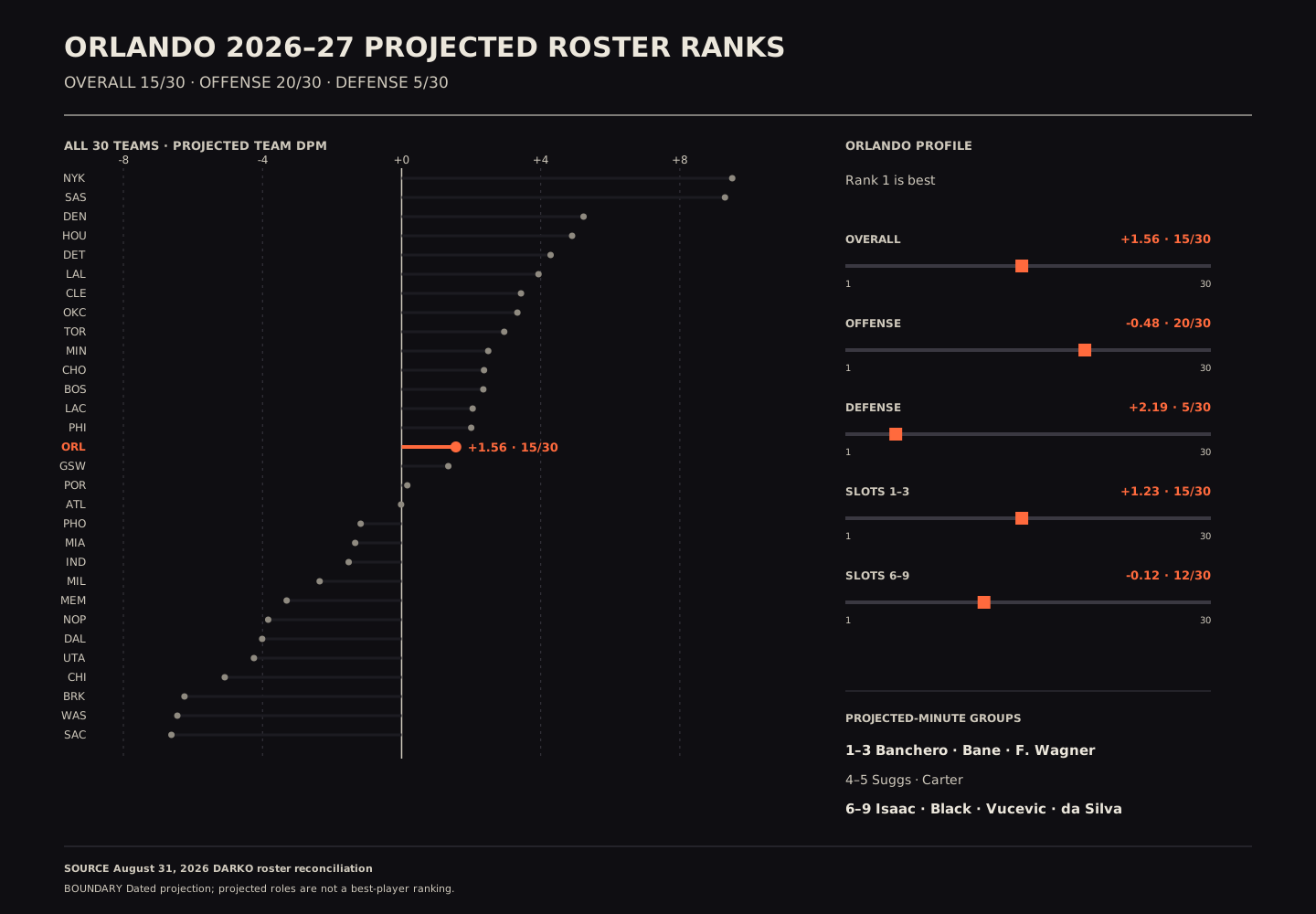
Ok, so the initial numbers here scream “middle of the pack.” The Magic roster currently sits 15th out of 30 teams in the overall roster projection according to total DPM. By all accounts, overall talent on this roster sits squarely in the middle third of the league.
To anyone who has watched the Magic over the past couple of seasons, this next piece will come as no surprise. The Magic rank 20th in offensive DPM. How much of this ranking is a result of underlying offensive capabilities versus Mosley’s stagnant, isolation-driven, downhill wing bully ball style of play is left to the reader’s own judgment.
It’s All About the Defense
So what’s so exciting about inheriting a roster with middle-of-the-pack talent?
Well, for one, you wouldn’t expect many openings to exist on teams with top talent! Of course, every few seasons a team with championship expectations (Knicks) will ditch their coach (Thibs) who has brought them to the championship gates in hopes a fresh voice can get them to the promised land. More often than not, the organizations churning through coaches and creating new head coach openings are those with weak talent and front offices that need a new scapegoat (looking at you Sacramento).
Taking a deeper look, we see that the Magic rank 5th in defensive DPM. Given that Sweeney was the former defensive czar of Dallas and last year’s Spurs’ defensive architect, we can start to see where some authentic excitement might be coming from regarding this current Magic roster.
Don’t Forget the Bench
Aside from looking at overall offensive and defensive rankings, it can be informative to look at the distribution of talent across the roster and how that stacks up.
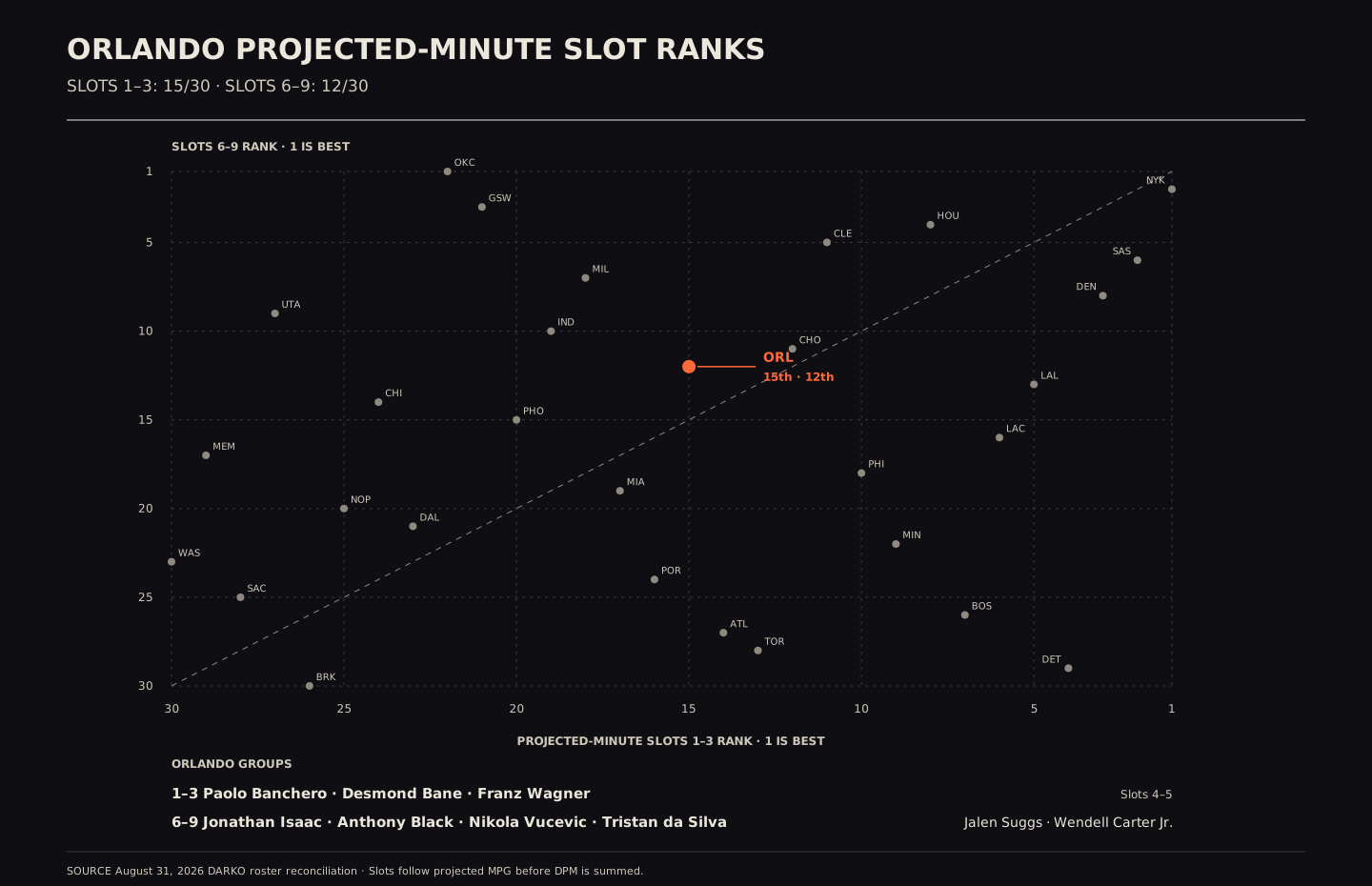
We can define roster spots (ranked by projected minutes) 1–9 according to projected minutes in the upcoming season. Projected minutes determine the rotation order and weight each player’s contribution after team minutes are normalized. If we focus on rotation spots 6–9, Orlando ranks 12th in DPM. The players filling those spots according to projected minutes are Jonathan Isaac, Anthony Black, Nikola Vucevic, and Tristan da Silva. When looking at projected-minute slots 1–3, consisting of Paolo Banchero, Desmond Bane, and Franz Wagner, Orlando drops back down to 15th (Suggs and Wendell Carter Jr. take spots 4 and 5). Top-heavy the Magic are not. Rotational depth is a slightly stronger aspect of this group, though not a compelling advantage over the rest of the league.
Was the Talent Wasted Under Mosley?
If we look at the July 2025 DPM snapshot going into last season, would we expect that team to perform better than the 45–37 record they posted? Orlando graded slightly lower prior to last year with a total DPM rank of 18.
We can start by creating a team talent score by converting the minutes-weighted average player into a five-player unit.
Team DPM = Σ(DPMᵢ × actual team-stint minutesᵢ) ÷ (48 × team games)
For the Orlando fold, we exclude them from the training data, fit the model on the remaining teams, and use the fitted model to predict Orlando’s Net Rating:
Actual Net Rating = a + b × Team DPM
With Orlando held out, the model trained on the other 29 teams predicted a +0.75 Net Rating from Orlando’s +0.92 team DPM.
Orlando’s observed Basketball Reference Net Rating was +0.56, which produces a slightly negative residual of -0.19. This is not a large enough difference to suggest that Mosley was underperforming the talent on the roster.
Residual = Actual - Predicted = 0.56 - 0.75 = -0.19
We repeat this process 30 times, holding each team out in one run, then fit the regression on the other 29 teams. Again, we predict the held-out team’s value and note the residual. Across the 30 team predictions, the MAE (mean absolute error) was 5.20 points per 100 possessions. Orlando’s absolute residual was 0.19 points per 100 possessions. This is tiny when compared to the model’s MAE of 5.20. Our limited model identifies no glaring evidence of Orlando’s overperformance or underperformance relative to the talent on the roster. Here, the model doesn’t tell us clearly that Mosley did or didn’t deliver results above or below the talent expectations.
So…Is The Talent Really That Exciting?
Time for me to pull my head out of the models and give some opinion. Is the talent on this roster enough to be excited about? It depends. If you’re a defensive-minded coach looking to dominate on defense, this roster will certainly inspire confidence. If you fancy yourself a coach who’s able to see what the last coach missed and squeeze more efficiency out of an offense that struggled to find a consistent rhythm, again, this could be a team that would make a coach excited to get to the gym each day.
Is the talent on the roster enough to make a coach feel like they are the missing ingredient needed to take that talent to the Eastern Conference Finals? Nope. But that doesn’t mean there isn’t plenty of room for improvement. If Sweeney can get the offense unstuck and better optimize individual shot selection and player usage, there’s no reason to think the current talent can’t make a deeper run than they have in the past few seasons.
So What’s Next?
Well, if we believe the recent results reasonably reflected the talent on the roster, is there any hope that the Magic can improve their performance this season? Yes! In the next post, we’ll test whether Orlando’s shot selection and volume left room for improvement and whether changing who takes which shots can make a big difference.